
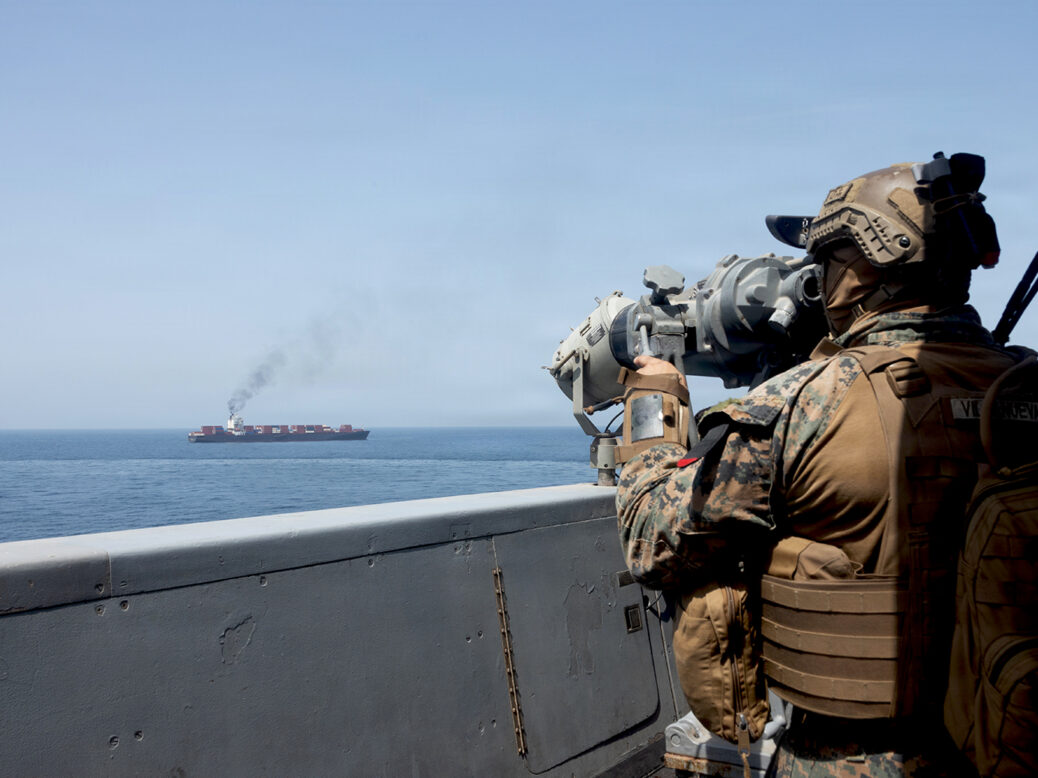
Over coming months, we are likely to hear a lot more about the “freedom of the seas”, because Iran and America’s blockade of the Straits of Hormuz has made this the burning issue of our time. What is happening there now could just as easily happen in the Straits of Melaka, the key maritime artery linking the Bay of Bengal to the South China Sea, and it has already been happening on a smaller scale in the Bab el-Mandeb, at the entrance to the Red Sea, thanks to the efforts of the Houthis. Overnight, it seems, we are moving from a world where shipping lanes that feed the global economy are international to one in which they are the exclusive property of warring states, with the capacity to “blast each other back to the Stone Age”.
Is this how history ends? Has the ultimate achievement of Homo sapiens – supposedly the wisest of creatures – been to build the perfect trap for its own demise?
In 2015, respected German lawyer and former judge at the International Tribunal for the Law of the Sea Rüdiger Wolfrum stated that: “Freedom of navigation is one of the oldest and most recognised principles in the legal regime governing ocean space.” He went on to explain that, since it was enshrined in Mare Liberum, a 1609 treatise by the Dutch jurist Hugo Grotius, this principle “constitutes one of the pillars of the law of the sea and was at the origins of modern international law”. One might be tempted to think that “freedom of the seas” was a peculiarly Western, liberal concept invented by Grotius – a major European thinker – and introduced into an ignorant Asia, mired in despotism, which has never come to terms with its true meaning. Iran’s actions would then serve to illustrate the point, with America claiming provocation. But nothing could be further from the truth.
Wolfrum was merely articulating a consensus, which has existed since the end of the Second World War. To understand the roots of the current predicament, we must dig deeper into its foundations. “Freedom of the seas” was introduced as a legal principle among the war-torn nations of 17th-century Europe, as a direct result of their competition for control over the spice trade of the Indian Ocean. Grotius wrote his treatise at the request of the Dutch East India Company, or VOC. When today’s lawyers and politicians refer in reverential tones to the “freedom of the sea” as a cornerstone of international law, what they often fail to point out is that its original purpose was to justify an act of war and piracy committed by the VOC against a Portuguese cargo ship in the Straits of Singapore.

Its main protagonist was Grotius’s own cousin, Admiral Jakob van Heemskerk, a survivor of Willem Barents’s disastrous expedition to the Arctic Ocean in search of a northern passage to Asia. Under his command, in February 1603, Dutch warships launched an attack on a Portuguese carrack called the Santa Catarina, which carried a freight of silk, spices, porcelain and other goods equivalent in value to half the capital holdings of the Company. The spoils were put up for sale in Amsterdam, and the VOC commissioned the brilliant young lawyer – Grotius – to write a treatise on their behalf, defending van Heemskerk’s actions to an incredulous world. Mare Liberum is an excerpt from it.
In fact, the full meaning of mare liberum, as expounded by Hugo Grotius, was that nations have a legal right to wage war on those who seek to obstruct the flow of commerce between parties who desire to engage in it. After the Second World War, Grotius was lionised as the “founder of international law” through the writings of luminaries such as Sir Hersch Lauterpacht, a judge in the International Court of Justice from 1955 to 1960. Lauterpacht adopted the Dutch scholar as a figurehead for the rules-based global order that he and his contemporaries were seeking to bring into being, a family of United Nations, joined in a pledge to never repeat the horrors of the recent past.
Since then, to speak of the “Grotian tradition” has meant invoking humanity’s best prospects for creating a system of international governance based, not on might, but on the rule of law – a world from which plunder, extortion, and genocide are banished. But castles built on sand have a habit of falling into the sea. In principle, Hugo Grotius argued for mare liberum – the freedom of the seas – while in practice his employer, the VOC, pursued ruthless policies of mare clausum (“closed sea”) across the Indian Ocean. Among other things, those policies included the perpetration, in 1621, of a genocide against the inhabitants of the Banda Islands, which secured Dutch control over what were then the world’s only sources of nutmeg and mace.
Should this history put current events in a different light? Are we now seeing a return to the true origins and meaning of mare liberum, in empire, colonisation and war? Or would we do better to confine our attention to rapidly unfolding events in the present? Surely what matters are the legal frameworks and what they stand for, rather than their historical roots in events that took place long before the world economy came to depend on oil and gas, or even before the invention of steamships. But to take this narrow view is to miss something crucial. Our present global arrangements are not just the result of commercial enterprise, brute force or empire. They were also, to begin with, works of political imagination. Assuming there is some way out of the present impasse, it will require further imagination to prevent the same script being played out again, to its lethal conclusion.
As a species, our prospects of living in a less menacing world are bound up with our capacity to understand the roots of the situation we now find ourselves in. We might begin by noting that just a few decades before Europe’s “age of discovery”, the Indian Ocean – including the Straits of Hormuz – very nearly became a Chinese-dominated sea (as some might wish to point out, this could still happen). In the early decades of the 15th century, Ming armadas sailed virtually unchallenged through the sea-lanes around the Malay Peninsula, India, Persia, and Arabia, and on to the Horn of Africa. By 1430, China was poised to assume hegemony over the whole region, from Java to Mozambique.
Instead, the Chinese withdrew. By the time Vasco da Gama’s ships rounded the Cape of Good Hope, in 1497, their armadas were long gone. Instead, what the Portuguese found was, to them, a puzzle. The Indian Ocean, at that time, was a world of vibrant maritime trade and cosmopolitan port-cities, reaching from the Swahili Coast of East Africa to the Malay Archipelago in Southeast Asia. Sea-traffic flowed from all sides. Some of the larger cities of the Malay Peninsula were comparable in size to those of the Iberia, but they had no city-walls. Money was widely used, and there were written legal codes, which laid down rules for the regulation of property and commerce on land. On the other hand, there seemed to be a clear understanding that nobody owned the seas.
How had this world come into being, without anyone asserting exclusive claims of ownership over the major ports and sea lanes, or backing up those rights with an apparatus of military control? Why had nobody already exercised imperium over the obvious chokepoints at the mouth of the Red Sea, and the Straits of Melaka and Hormuz? The Portuguese historian João de Barros wrote that the waters of Asia had not been claimed by any sovereign and “the Portuguese as Lords of the Sea are justified in confiscating the goods of all those who navigate the seas without their permission”. He also conceded that an alternative set of laws was already in place, which ensured a “common right to all to navigate the seas”, but added that Portugal was under no obligation to follow such heathen customs.
In the early decades of the 16th century, Portuguese fleets would blast, burn and bargain their way through the ports of the Swahili Coast, the Persian Gulf, Gujarat, Malabar, then on to the Bay of Bengal, the Malay Peninsula, and finally the spice islands of Maluku and the Banda Sea. Along the way, they built a network of forts overlooking important coastal towns, including Hormuz. Their maritime empire, the Estado da Índia, introduced a policy of mare clausum, restricting the passage of merchant ships, which were required to carry a navicert or maritime passport called a cartaz. Any vessel found to be sailing without one was considered fair game for bombardment and plunder.
By the 1550s, Portugal claimed exclusive rights over the Straits of Melaka, critical to the global spice trade. In response, several other things happened, which had effects that reverberate down to the present day. One, as we’ve seen, was the articulation of “freedom of the seas” as a legal doctrine of just war, on which much now hinges. Another was the articulation of jihad, also as just war, in response to Portuguese depredations on the Malabar coast of southern India. Gift of the Mujahidin: Some Accounts of the Portuguese was composed in 1583 by Zayn al-Din al-Malibari, a Sunni jurist from Kerala. Citing Portuguese efforts to monopolise the spice trade and atrocities committed in Calicut and Malabar, he called for armed resistance in defence of a civilisation where people of different faiths had co-existed but now were tearing at each other’s throats.
Al-Malibari was polemicising, but he was not simply making things up. The great age of commerce in the Indian Ocean was also an age of hospitality. Melaka, the largest port-city on the Malay Peninsula, hosted residential enclaves of Chinese, Tamils (mostly Hindu), Javanese and Gujarati Muslims. Indian merchants had links with trading families in Aden and Hormuz, the key ports of the Arabian Sea and the Persian Gulf. Tamils traded widely around the Bay of Bengal and the South China Sea. Javanese residents kept close connections with the pasasir ports of their homeland and conducted maritime trade throughout the neighbouring islands of the archipelago, from Luzon in the Philippines down to Banda. Jews, Armenians, Persians and Yemenis all settled in Melaka.
Grotius, in fact, began his Mare Liberum by observing how the right to engage in commerce is enshrined in laws of hospitality. Such laws, he claimed, are “sacrosanct” and take precedence over the laws of individual nations (he was drawing here on the writings of Francisco de Vitoria and the School of Salamanca). The Portuguese, by sending warships to blockade the entrances to kingdoms that wished to host and trade with the Dutch, were thus acting contrary to God and natural law. But he then abandoned this theme, and moved on to develop an argument made by ancient authors such as Virgil and Cicero, about how certain things in nature – such as the seas, air, and the light of the sun – can’t be fenced off or enclosed, so it would be against the laws of nature to treat them as private property, as the Portuguese were doing with the waters of the Indian Ocean.
In practice, the Dutch went on to pursue just the opposite of mare liberum. By the middle of the 17th century, the VOC held a monopoly on the spice trade more complete than anything achieved by the Portuguese, enforced by blockades and a new passport system. At a 1615 conference in London, the English East India Company had defended its own right to participate in the spice trade, not against Portugal, but against the Dutch. English lawyers quoted extensively from Mare Liberum, unaware that its author was standing right in front of them as the Dutch Republic’s chief delegate to London. Grotius took evasive action and argued against the principles of his own treatise.
Perhaps the real tragedy of all this is that the waters of Grotius’s Mare Liberum contain materials for an entirely different history of human freedoms to the one he bequeathed us. In 1615, responding to VOC demands that Makassar – a major port in South Sulawesi – should cut off trade with the Spice Islands, its ruler, Sultan Ala’ud-Din replied: “My country is open to all nations… God created the earth and sea, divided the earth among people and gave them the sea in common. It is a thing unheard of that anyone should be forbidden to sail the seas. If you did this, it would be like taking bread away from the mouths of the people.” Nor were these just empty words or legal bluster.
Makassar, at the time, had lifted tariffs on maritime trade and championed an open gateway policy of welcoming traders, including Dutch and Portuguese, who came there to buy spices from the Maluku Islands. It was also a haven of relative peace and religious tolerance, where foreign communities at war elsewhere would lay down their arms. There’s an obvious irony here. As a principle of international law, freedom of navigation is attributed – not to those who both practised and preached it – but to Grotius, in the service of a business corporation whose sole purpose was to achieve the opposite, by enforcing trade monopolies and exclusive control over the sea-lanes of the Indian Ocean. One could, in fact, go much further. Some scholars resist the idea that Mare Liberum was influenced by contemporary Asian maritime laws and practices, or even by the interplay of European and Asian ideas in the Indian Ocean, but others are open to the possibilities.
Either way, it is striking that in private letters to the sultans and rajas of the East Indies, drafted by Grotius on behalf of the VOC, the Dutch lawyer espoused a concept of liberty that is starkly at odds with his own arguments in Mare Liberum. Liberty is the basis of your friendship with the Dutch, he wrote, but freedom and security must be paid for. Wars fought to liberate the Indies from Iberian tyranny are expensive, he reminds the local sultans, and the costs should be met by granting the VOC permanent and exclusive rights to purchase harvests of cloves and nutmeg, at fixed prices.
In the name of liberty, a system of global relationships predicated on violence and extortion was being created. For those with power, it meant the freedom to impose conditions on the weak at will; for those who lacked it, it meant the “freedom” to take part in a game that was not of their own making. As Grotius himself would later put it, there can be “no peace among nations without armies, no armies without pay, and no pay without tribute”, sentiments echoed a century later by Charles Boone, British Governor of Bombay: “if no naval force no trade, if no fear no friendship”.
We are likely to be hearing a lot more about the “freedom of the seas”. As a legal principle, today, it frames decisions not just about the global economy, but also about war and peace, migration and political asylum, and climate-driven expansion of the world’s oceans. Those who invoke this principle might remember not just how it entered international law, in the service of Europe’s conquests in the Indian Ocean, but also that those same waters contain other histories of freedom, grounded in principles of hospitality, rather than the capacity to bully and bomb one’s enemies into submission.
Back in the 1960s, the Polish legal scholar CH Alexandrowicz argued that our conventional story of the origins of international law is back to front. After the Second World War, the newly independent nations of Africa and Asia were generally regarded as virgin actors on the international stage, with no prior experience of sovereignty. According to Alexandrowicz, this is wrong. In fact, many of those nations had already enjoyed full recognition of their sovereignty as early as the 16th century. Grotius himself wrote in such terms about the East Indies. The Portuguese, he insisted, could not be considered rightful owners of places in Sumatra or the Maluku Islands, since they “now have, and always have had, their own rulers, governments, laws and rights”.
What brought this to an end was imperial conquest, which meant non-Europeans were excluded from the “family of nations”, then forced to apply for readmission on Western terms, as junior partners with limited influence over decisions made by states, whose conquests had by then made them inordinately rich and powerful. If so, then perhaps what we are now witnessing around the Straits of Hormuz is not just the humbling of the American military machine, but a genuine turning of the tide, away from a world order imposed by the West, and back to one where questions of mare liberum are litigated among different traditions.
[Further reading: Why the Western mind cannot comprehend Iran]
Content from our partners



Related
Join the debate
Subscribe here to comment